
What Is a Fractional CFO? Complete Guide for Small Business
March 6, 2026 | Katie Thoma
You’re growing. Revenue is climbing. But the financial decisions are getting more complex, and you’re making gut-feel calls that keep you up at night. Cash flow surprises hit when you least expect them. You know you need strategic financial guidance, but a $300,000+ CFO salary isn’t in the budget.
This is exactly the challenge that fractional CFOs solve. In 2026, demand for fractional CFO services surged 103% as small businesses discovered they could access C-suite financial expertise without the full-time commitment. If you’ve been wondering whether your business needs a CFO but aren’t ready to hire one full-time, this guide will show you exactly what fractional CFOs do, what they cost, and when it makes sense to bring one on board.

What Is a Fractional CFO?
A fractional CFO is a part-time Chief Financial Officer who provides strategic financial leadership to your business on a flexible, as-needed basis. Unlike a full-time CFO who works exclusively for one company, a fractional CFO typically serves multiple clients simultaneously, dedicating 20-40 hours per month to each business.
Think of it as having a seasoned financial executive in your corner without the six-figure salary commitment. Fractional CFOs bring the same caliber of expertise you’d expect from a Fortune 500 finance leader, they just work on a retainer or project basis instead of a traditional employment arrangement.
The model has exploded in recent years. Google searches for “fractional CFO” grew 535% between 2021 and 2022, and the number of fractional leadership professionals doubled from 60,000 to 120,000 between 2022 and 2024. This isn’t a niche trend anymore, it’s how modern small businesses access top-tier financial talent.
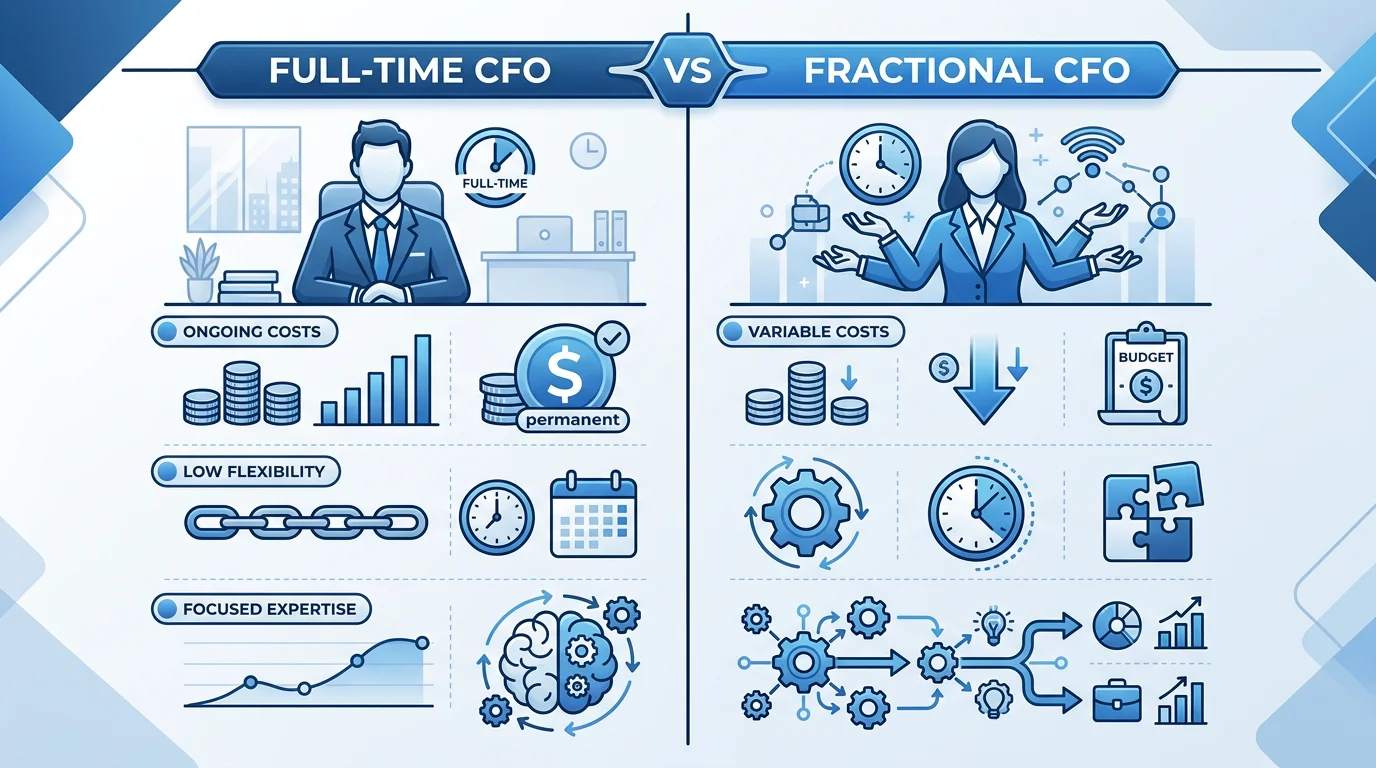
Fractional CFO vs. Full-Time CFO: Understanding the Difference
The most obvious difference is cost. According to industry research from Bill.com, the average full-time CFO salary is $441,000 per year before benefits, stock options, and overhead. When you factor in the total compensation package, you’re looking at $300,000 to $500,000 annually for a full-time CFO.
A fractional CFO typically costs $3,000 to $15,000 per month depending on your business complexity and the hours required. That’s 60-80% cost savings compared to hiring full-time.

When a Full-Time CFO Makes Sense
- Your company generates $50M+ in annual revenue
- You’re managing complex financial operations across multiple entities or countries
- You’re preparing for an IPO or major acquisition
- You need someone in the office 40+ hours per week managing a large finance team
- You have the budget and workload to justify the investment
When a Fractional CFO Is the Right Fit
- Your revenue is between $500,000 and $20M annually
- You need strategic financial guidance but not daily oversight
- You’re in growth mode and need scenario planning and forecasting
- You want access to senior-level expertise without the full-time commitment
- You need project-based support like fundraising prep or financial systems implementation
As NOW CFO explains, the fractional model gives you flexibility to scale financial leadership up or down as your needs change. If you’re growing rapidly, you can increase hours. If you hit a slower season, you can dial back the engagement.
Services a Fractional CFO Provides
Fractional CFOs aren’t bookkeepers or accountants, they’re strategic partners who focus on the big picture. While foundational bookkeeping handles day-to-day transaction recording, fractional CFO services operate at a different level entirely.
Strategic Financial Planning and Forecasting
A fractional CFO builds financial models that show you where your business is headed. They create 12-month and multi-year projections based on your growth assumptions, helping you understand cash needs before you hit a crunch. They answer questions like: Can we afford to hire three new people? What happens to our cash position if sales slow down by 20%?
Cash Flow Management and Analysis
Poor cash flow kills profitable businesses. Your fractional CFO monitors cash flow patterns, identifies potential shortfalls before they happen, and recommends adjustments to payment terms, collections processes, or financing strategies. They turn financial reporting data into actionable insights.
Budgeting and Scenario Planning
They build comprehensive budgets that align with your strategic goals and create scenario models for different business conditions. What if revenue grows 30%? What if you acquire a competitor? What if supply costs increase? These “what-if” analyses help you make confident decisions.
Fundraising and Investor Relations
If you’re raising capital, a fractional CFO prepares the financial materials investors expect: detailed financial statements, projections, cap tables, and pitch deck financials. They can participate in due diligence and help negotiate deal terms.
Financial Systems and Process Improvement
Many fractional CFOs help implement or optimize financial systems. This might include QuickBooks setup and management, integrating billing systems, or establishing financial dashboards that give you real-time visibility into key metrics.
KPI Development and Reporting
They identify the financial metrics that matter most for your business model and create reporting structures so you can track them consistently. Not vanity metrics, the numbers that actually drive profitability and growth.
When Your Small Business Needs a Fractional CFO
According to NerdWallet’s fractional CFO guide, most businesses start considering fractional CFO services when they cross the $500,000 to $1 million revenue threshold. But revenue alone isn’t the only trigger. Here are the clearest signs it’s time to bring in fractional CFO expertise:
Red Flags That Signal You Need a Fractional CFO
- Cash flow surprises: You’re frequently caught off guard by cash shortages despite healthy sales
- Gut-feel decisions: You’re making major financial decisions based on intuition rather than data and projections
- Banking relationships: You need to secure a credit line or loan but lack the financial documentation to support your application
- Growth planning: You want to expand but don’t know if the numbers support it
- Investor conversations: You’re entering fundraising discussions and need investor-ready financials
- Profitability questions: Revenue is growing but you’re not sure if you’re actually profitable on a unit-by-unit or project-by-project basis
- Complexity increasing: You’re adding new revenue streams, products, or markets and need financial structure to support the expansion
Growth Phases Where Fractional CFOs Add the Most Value
Early growth stage ($500K-$2M revenue): Building financial infrastructure, establishing forecasting models, and creating budgets that support scaling.
Scaling phase ($2M-$10M revenue): Managing increased complexity, optimizing cash flow, supporting fundraising efforts, and preparing for potential exit scenarios.
Pre-exit or acquisition: Preparing financials for due diligence, maximizing business valuation, and navigating transaction processes.
With 83% of small and medium enterprises now engaging external firms for non-core functions, outsourcing strategic financial leadership has become the norm rather than the exception.
Key Benefits of Hiring a Fractional CFO
Massive Cost Savings Without Sacrificing Expertise
The 60-80% cost reduction compared to full-time hires is significant, but it’s not just about saving money. It’s about accessing expertise that would otherwise be out of reach. Most small businesses simply cannot justify or afford a $300,000+ salary, but they can absolutely benefit from the strategic thinking that comes with that level of experience.
Strategic Perspective from Diverse Experience
Fractional CFOs typically work with multiple companies across different industries. This means they bring pattern recognition and best practices from other businesses to your situation. They’ve seen what works and what doesn’t across dozens of scenarios.
Data-Driven Decision Making
Instead of relying on intuition, you’ll have financial models, forecasts, and analyses backing up major decisions. This reduces risk and increases confidence when you’re making significant investments or strategic pivots.
Scalability and Flexibility
Your financial leadership needs change as your business evolves. The fractional model lets you scale up during growth phases or fundraising periods, and scale back during stable periods. You’re not locked into a fixed overhead expense.
Faster Time to Value
Experienced fractional CFOs can quickly assess your situation and start delivering value within weeks, not months. They’ve done this before and know exactly what to look for and how to prioritize.
Credibility with Banks, Investors, and Partners
Having a credentialed CFO on your leadership team signals financial maturity to external stakeholders. Banks are more willing to extend credit. Investors take you more seriously. Strategic partners see you as a stable, well-managed operation.
Fractional CFO Cost and Pricing Models
Fractional CFO services typically cost between $3,000 and $15,000 per month depending on several factors. Understanding the pricing structure helps you budget appropriately and evaluate ROI.
Monthly Retainer Model
This is the most common structure. You pay a fixed monthly fee for a set number of hours (typically 10-40 hours per month). This gives you predictable costs and guaranteed access to your fractional CFO for strategic planning sessions, financial reviews, and ongoing advisory support.
Hourly Rate Structure
Some fractional CFOs work on an hourly basis, typically charging $150 to $500 per hour depending on experience and location. This model works well for project-based needs like preparing for fundraising or implementing new financial systems.
Project-Based Pricing
For defined projects like fundraising preparation, financial due diligence, or system implementations, some CFOs offer fixed project fees. These typically range from $5,000 to $50,000 depending on scope and complexity.
Factors That Affect Fractional CFO Cost
- Business complexity: Multiple entities, international operations, or complex revenue models increase the work required
- Revenue and transaction volume: Larger businesses with more financial activity require more CFO time
- CFO experience and credentials: CPA certification, industry specialization, and years of experience command higher rates
- Service scope: Strategic planning only vs. full-service including systems implementation and team management
- Geographic location: Rates vary by market, though remote work has somewhat equalized pricing
ROI Perspective
When evaluating cost, consider the ROI. A fractional CFO who helps you secure better lending terms, avoid a costly cash flow crisis, or increase profitability by optimizing pricing can deliver returns that dwarf their fees. One avoided mistake or one improved decision can pay for months of fractional CFO services.
How to Choose and Work with a Fractional CFO
Credentials and Experience to Look For
- CPA certification: While not mandatory, it demonstrates technical accounting expertise
- Relevant industry experience: Someone who understands your business model and industry dynamics will deliver faster value
- Track record: Ask for references from other clients in similar situations
- Strategic thinking: Look for someone who asks great questions and demonstrates business acumen beyond just numbers
- Communication skills: They need to translate complex financial concepts into clear, actionable insights
Questions to Ask Before Hiring
- What industries and business models do you specialize in?
- How many clients do you currently serve, and how will you prioritize my needs?
- What financial systems and tools are you experienced with?
- Can you provide references from businesses similar to mine?
- What deliverables and reporting should I expect?
- How do you structure your engagement, and what’s your availability?
Setting Up for Success
Once you’ve hired a fractional CFO, integration is key. Give them access to all relevant financial systems and historical data. Schedule regular check-ins, typically weekly or bi-weekly. Be clear about your goals and the decisions you’re facing. The more context they have about your business strategy, the more valuable their financial guidance will be.
Many businesses find value in starting with integrated financial services that can scale from bookkeeping to controller-level functions to full CFO support as needs evolve. This creates continuity and ensures your CFO is working with clean, reliable financial data from the start.
Frequently Asked Questions
What is the difference between a fractional CFO and a bookkeeper?
A bookkeeper records daily financial transactions and maintains your general ledger. A fractional CFO provides strategic financial leadership including forecasting, cash flow analysis, budgeting, and executive-level decision support. Most businesses need both, bookkeepers handle the foundation while CFOs focus on strategy and planning.
How many hours per month does a fractional CFO typically work?
Most fractional CFO engagements involve 10 to 40 hours per month depending on business complexity and needs. Early-stage companies might start with 10-15 hours monthly, while more complex or rapidly growing businesses might need 30-40 hours for comprehensive CFO services.
Can a fractional CFO help with fundraising?
Yes, preparing financial materials for investors is one of the most common reasons businesses hire fractional CFOs. They create financial projections, prepare pitch deck financials, develop cap tables, and participate in due diligence processes. Their involvement signals financial credibility to potential investors.
At what revenue level should I hire a fractional CFO?
Most businesses start considering fractional CFO services between $500,000 and $1 million in annual revenue, though the right timing depends more on complexity and growth trajectory than revenue alone. If you’re facing strategic financial decisions, preparing for fundraising, or experiencing cash flow challenges, it may be time regardless of revenue.
How is fractional CFO different from an outsourced CFO?
The terms are often used interchangeably. Both refer to part-time CFO services provided on a contract basis rather than through traditional employment. Some use “fractional” to emphasize the part-time nature, while “outsourced” emphasizes that the CFO works independently or through a firm rather than as an employee.
Conclusion: Is a Fractional CFO Right for Your Business?
The fractional CFO model has fundamentally changed how small businesses access financial expertise. With the global finance and accounting outsourcing market projected to reach $76.4 billion by 2033 and over 35% of U.S. small businesses now outsourcing at least one core operation, the question isn’t whether outsourced financial leadership is legitimate, it’s whether your business can afford not to have strategic CFO guidance.
If you’re making significant financial decisions without solid data and projections, if cash flow surprises keep hitting you, or if you’re preparing for growth that requires more sophisticated financial management, fractional CFO services deliver the expertise you need without the full-time expense.
The key is finding the right partner who understands your industry, communicates clearly, and integrates seamlessly with your existing operations. At Moxie Assist, we offer a complete spectrum of financial services from foundational bookkeeping through controller-level functions to full CFO strategic support. This integrated approach means your CFO works with clean, reliable data and understands your business from the ground up.
Ready to explore how fractional CFO services could support your growth? Learn more about Moxie Assist’s financial support services and fractional CFO services, or reach out to discuss your needs. Your next growth phase deserves the financial leadership to support it.